
|
In summer I researched and wrote a new resource for history and heritage educators on behalf of Curious Minds. Drawing together examples from across the North West, covering an array of indoor and outdoor museum and heritage locations, it explores how schools and heritage organisations have worked together to help young people learn about their local history in cross-curricular ways. It's particularly relevant to the Key Stage 2 curricula but extends to KS1 and KS3 too. Browse or download above, or from my resources page.
Each case study includes - Description of a topic or activity - Objectives and outcomes of the activity - Practical activity suggestions to include in topics / lesson plans - Top tips for planning and practicalities - Links to further resources Includes five example case studies of projects by schools and museum or heritage sites working together cover these overarching themes: - Investigating a heritage site (through the ages and a timeline) - Investigating a local street (in this instance Victorian but transferable to other periods) - Investigating a historical period (Stone, Bronze and Iron ages) - Creative engagement with maths (using the art / design of Blackpool Illuminations to cover the full KS1 & 2 maths curriculum) - Exploring the local town (in this instance a coastal town with a migratory mining history) Current History links - the lives of significant individuals in the past who have contributed to national and international achievements - significant historical events, people and places in their own locality - changes in Britain from the Stone Age to the Iron Age - a study of an aspect or theme in British history that extends pupils’ chronological knowledge beyond 1066 - ideas, political power, industry and empire: Britain, 1745-1901 With a foreward from Prof. Kerri Facer - education innovator and advocate for place-based curricula.
0 Comments
1/5/2011 One Small Step for Early Years, One Giant Leap for Children: a toolkit for creativity with young childrenRead Now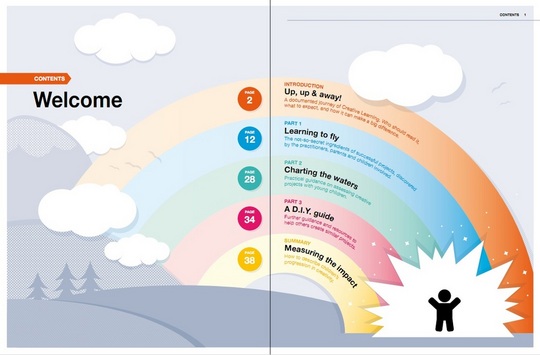 This time last year I was lucky enough to work with Isaacs UK and CAPE UK, exploring the work of artists and creative practitioners working with children and staff in ten early years settings across Leeds. They settings worked together as network, using Creative Partnerships' enquiry model of working to test out their activities. My role was to pull together everyone's learning, summarising shared findings and exceptional experiences, laying these out in a way which might be helpful for others looking for new and / or creative ways to unlock potential in their children. To round up a few of the ups and downs, things that worked, things that didn't work quite so much, and some of the thinking the creative and early years practitioners travelled through together or separately. At the heart of it all, to tell some of the stories of the children and how their outlook on the world changed a little as a result of the projects. On a more formal side, we looked at a couple of different ways of monitoring the progress of children - both in terms of the Foundation Stage areas, and in their wellbeing and involvement through a system known as EXE (Experiential Education). CAPE set some fantastic designers loose on the content I wrote with IsaacsUK, and the result is a really stunning and accessible looking publication. Please read, browse, enjoy and most importantly - pass it on to anyone who might make use of it. Browse or download it below, or online *here*  About four years ago I was asked to work as cultural and educational consultant for a Culture Online funded pilot project called MyArtSpace. We worked with three venues - Urbis in Manchester, The Study Gallery, now KUBE, in Poole and the D-Day Museum in Portsmouth. MyArtSpace was one of the early systems for interpreting and sharing collections and exhibitions digitally using mobile phones. Organisations listed exhibits or artefacts on a database, along with images and interesting facts. These were then transferred to a system which visitors could access via specially programmed mobile phones.
As visitors encountered an object showing a code around the venue or site, they entered the code into the phone, which brought up a corresponding image and information. Visitors could then take a photo, record sounds, and add additonal notes, thoughts, facts etc to this object's 'record.' This was then saved to a personalised storeroom belonging just to that one visitor, which they accessed on the internet later on. Through their collection in this on line storeroom they could then select, order, and present items to create unique exhibitions; then share them with other users through the MyArtSpace website. After the pilot phase, MyArtSpace became OOKL as we realised the potential for the service expanded way beyond just art, and we didn't want to restrict usage. Museums, botanic gardens and a wide range of other spaces and places began to come on board. Now, with leaps and bounds of advances in digital technology and a web revolution, the power of OOKL has stepped up to gears previously incomprehensible. January saw an i-phone app launched which has opened up access to the service and its thousands of objects. More than three venues per week are now signing up to use OOKL. If you want to find out more about using OOKL as a venue or a visitor, read on... |
...BlogI'm most interested in how the public, your public, whoever that may be, engages with culture and creativity.
And if it nurtures creativity and develops personal, social or professional skills I'm absolutely all ears. 
Categories
All
Archives
May 2023
|
 RSS Feed
